

Protecting Forests, Preventing Human & Wildlife Conflict: A Community-Led Approach in Uganda
Support an important conservation project in western Uganda and help protect wild chimpanzees and their habitats and Preventing Human & Wildlife Conflict!
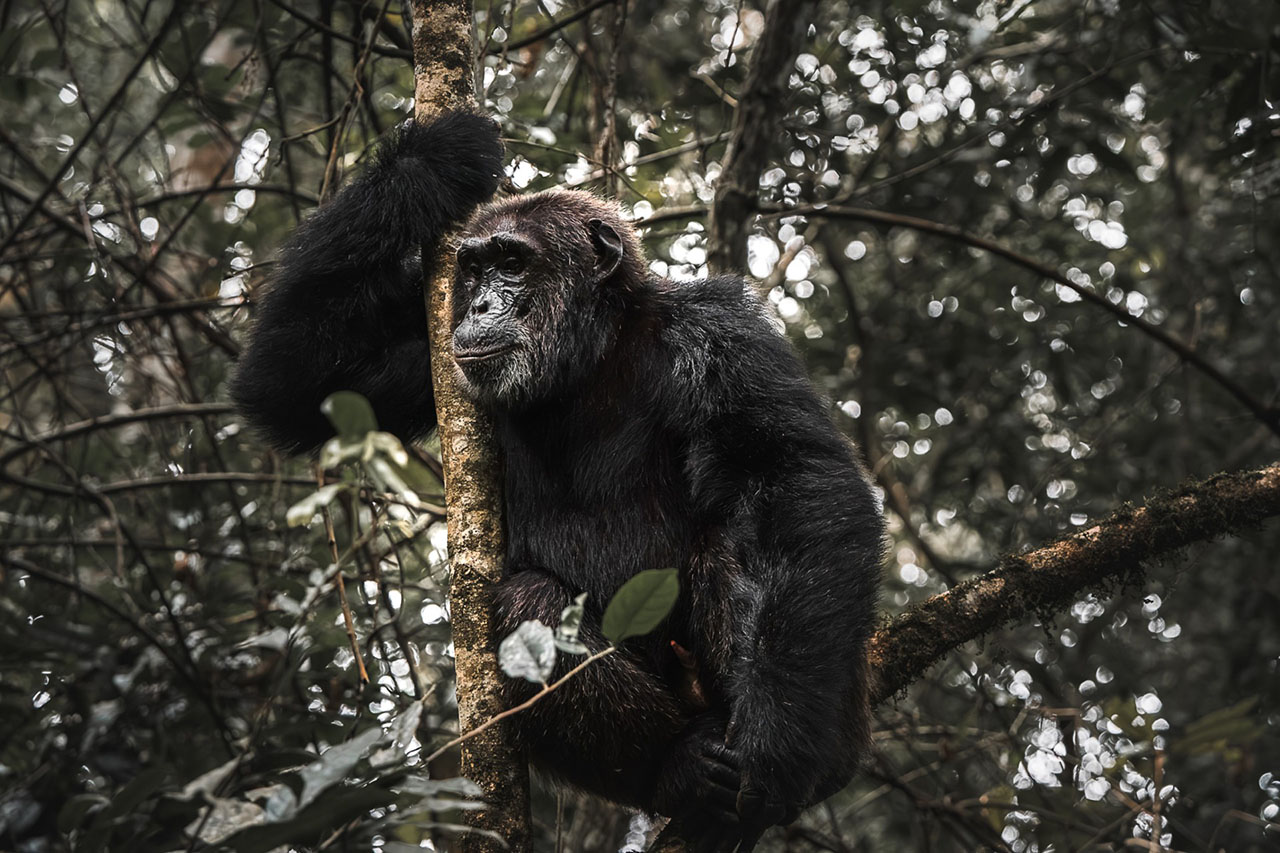
You Will Gain Experience with Chimpanzees in Their Natural Habitat and Witness the Very Real Issues Threatening Their Survival.
The Thrill Of This Fully Immersive Program Is An Experience That Lasts A Lifetime!
Uganda’s tropical forests are among the richest ecosystems in Africa, and they are home to one of our closest relatives: the chimpanzee. In Uganda’s Albertine Rift, the Itohya Forest stands as an ecological stronghold, home to endangered Eastern chimpanzees and other wildlife. The 800-acre forest, a privately owned reserve, is surrounded by nine villages. Many farmers view the forest as an obstacle to farmland expansion rather than an asset. As a result, the forest is under increasing pressure from encroachment, and human-wildlife conflicts have become more frequent in this private forest area around Munteme Village, a community where around 100 wild chimpanzees live, whose protection and research are at the heart of this Volunteer Project.
As they move through the forest, chimpanzees disperse seeds over large distances, contributing to the natural regeneration of the woodland. This helps to increase plant diversity, stabilise ecosystems, and secure long-term habitats for many species. Protecting these primates, therefore, always means protecting entire landscapes.
However, their habitats are shrinking due to agriculture, infrastructure, and human activity. This project addresses these threats directly: through research, habitat restoration, and environmental education, it strengthens the long-term protection of chimpanzees and other wildlife.
As a participant, you will join a small team of no more than five people. Together with local guides and conservation experts, you will collect valuable data on chimpanzee behaviour, assist with practical conservation work in the forest, and gain a deep understanding of the complex relationship between humans, nature, and culture in Uganda. Plan your conservation adventure to Uganda now!
Arrival in Uganda
After you arrive at Entebbe International Airport, your journey continues westward into the country. During the transfer to the Bunyoro region, you will already experience the beauty of Uganda: green hills, small villages, and vast landscapes pass by as you travel.
Upon arrival at the project camp, you will meet the team and the other volunteers. An introduction will prepare you for your tasks in the volunteer project and for respectful interaction with wildlife and nature.
Activities as a volunteer in Chimpanzee Conservation
As a volunteer, you will support the team in a variety of conservation activities focused on protecting chimpanzees and their habitats. A key part of your role is chimpanzee behavioural observation, where you will work alongside local guides to record important data on activity patterns, social interactions, and movement within the group.
In addition, you will take part in ecological monitoring activities, including forest walks, nest counts, bird and mammal surveys, and identification of tropical tree species. Another important aspect of your work is habitat restoration: you will assist with tree planting, conducting ecological surveys, and building beehives, which benefit both biodiversity and local communities.
Accommodation in Uganda
During your stay, you will live in simple, clean, and comfortable self-contained private rooms at the project camp. The rooms are equipped with beds and bedding, fans, and storage for your clothes. Electricity and hot showers are available, but Wi-Fi is not always reliable.
Meals and free time in Uganda
You will receive three freshly prepared meals a day: breakfast, lunch, and dinner, served communally in the dining area. The meals are simple and locally inspired, and vegetarian options are possible.
In your free time, you can explore the nature around the camp, take excursions to nearby protected areas such as a wildlife safari at the Murchison Falls National or simply enjoy the unique atmosphere of Uganda’s forest.
Wildlife Conservation in Uganda
Uganda is one of Africa’s key regions for the protection of primates and tropical forests. Projects like this play a vital role in preserving biodiversity, combining research, practical conservation work, and environmental education. Protecting chimpanzees also safeguards entire forest ecosystems, helping to maintain vital resources such as water, fertile soils, and natural carbon stores.
DETAILED SECTION
Travel – Arrival in Uganda
Your journey begins with an international flight to Entebbe International Airport, Uganda’s main airport. From there, the project arranges a transfer to the Bunyoro region in western Uganda. The drive takes you through diverse landscapes: past small villages, green hills, agricultural areas, and forests. Along the way, you will gain an initial impression of daily life in Uganda and the richness of its natural environment.
Upon arrival at the project camp, you will meet the team and the other volunteers. During an orientation session, you will receive essential information on the project schedule, forest safety, and how to behave around wildlife. Afterward, you will have time to settle in and explore the surroundings before your first project days begin.
Structure – Typical day at the volunteer project
Your day usually begins early at around 7:00 am, with the team heading into the forest to observe chimpanzees or collect ecological data. Afterwards, with a communal breakfast in the camp at 10:00 am.
Every day is different as animals rarely operate to our schedule – we ask that you remain flexible. While the schedule may vary, your work day will begin each day at 7:00 am and work through to 5 pm, inclusive of breaks in all the conservation locations. You will gain valuable knowledge and skills as you learn from our team of experts about animal movements and behaviour of chimpanzees, baboons, monkeys, and bush babies, as well as many other exquisite species. All the data collected on these wild, yet vulnerable animals, contributes towards protecting and conserving them. You will have two rest days each week.
During behavioural observations, you will record activities such as feeding, social interactions, and movement patterns within the group. This information provides critical insights for the long-term protection of the population.
On other days, you will assist with practical conservation work. This includes planting young trees to restore the forest, setting up tree nurseries, or constructing beehives, which benefit both biodiversity and local communities.
Ecological monitoring activities are also part of the programme, such as birdwatching, counting mammals, identifying tropical trees, or mapping forest areas.
The workday ends at around 5:00 pm. Afterwards, there is time to relax, connect with fellow volunteers, or enjoy the sunset over the forest. You will have two days off per week.
Region – Western Uganda
The project takes place in western Uganda, within the culturally rich Bunyoro subregion, an area shaped by fertile landscapes, rural communities, and deep historical roots. The wider region lies within the Albertine Rift, one of Africa’s most important biodiversity hotspots, known for its remarkable ecological diversity.
The landscape here is characterised by gently rolling hills, savannah woodland, and agricultural plains. Small farms dominate the countryside, where crops such as maize, beans, cassava, bananas, and sugarcane provide the basis for local livelihoods. While the immediate project areas are primarily rural and agricultural, the surrounding Albertine Rift region supports a wide variety of wildlife, including primates, antelopes, and diverse bird species.
Your experience takes place in Munteme village in the Bunyoro region in Kikuube District, near Hoima city, located within the Albertine region near Lake Albert. This area is characterised by strong community structures, rural trading centres, and agricultural livelihoods.
Culturally, the region is closely connected to the traditions of the historic Bunyoro-Kitara Kingdom, one of Uganda’s oldest kingdoms. Its heritage continues to influence daily life through traditional customs, storytelling, music, and crafts.
Throughout the programme, participants explore the connections between community life, sustainable livelihoods, and environmental stewardship, gaining insight into how local communities balance economic development with the protection of their natural environment.
Departure – Saying farewell to the project
At the end of your volunteer project, you will say goodbye to the team, the forest, and the chimpanzees you have had the privilege to witness. The project will organise your transfer back to Entebbe, where your return flight departs. Many volunteers take the opportunity to extend their journey and explore more of Uganda’s natural highlights, such as the Murchison Falls National Park or the crater lakes around Fort Portal. With new experiences in conservation, memorable encounters, and countless memories, you will return home carrying a piece of Uganda with you.
Background of the Chimpanzee Conservation Project
This volunteer project was established to protect private forest areas in the Bunyoro region and to conduct detailed scientific research on chimpanzee populations. The project focuses on the conservation of these critically important primates, whose presence is essential for maintaining healthy forest ecosystems. By studying their behaviour, social interactions, and habitat use, volunteers and researchers gain vital insights that inform effective protection strategies.
In addition to chimpanzee observation, the project undertakes habitat restoration, including tree planting and forest rehabilitation, to ensure the long-term survival of both the primates and the wider biodiversity they support. Environmental education and close collaboration with local communities form a core part of the programme, fostering awareness, long-term livelihoods, and human-wildlife coexistence.
Through these combined efforts, the project aims to safeguard chimpanzees and other wildlife, preserve vital forest ecosystems, and develop science-based, nature- and people-sensitive conservation strategies
Volunteer With Justice Tourism Foundation
Join Our Global Community Of Impact-Minded (Conscious) Travelers Who Want To Move Beyond Traditional Tourism To Engage In Genuine Cross-Cultural Connection And Learning Opportunities – Inspiring Compassion Towards Fellow Human Beings.